

1080 Glass Cloth is a lightweight, plain-woven glass reinforcement used in electronic laminates and PCB prepregs. Published supplier examples weigh about 47–49 g/m², with dry-fabric thickness around 0.05–0.06 mm. Its thin construction helps engineers build closely spaced copper layers without using a heavier glass fabric. However, a PCB does not use the dry-cloth dimension as its finished insulation thickness.
The resin grade, resin content, number of plies and lamination conditions determine the actual dielectric build. Selecting 1080 therefore means choosing a complete prepreg construction, not simply requesting the thinnest available fabric.
Key Takeaways
- 1080 is a glass-fabric construction used to reinforce resin-based PCB dielectric layers.
- Representative dry-fabric data are approximately 47–49 g/m² and 0.05–0.06 mm; supplier specifications and measurement conditions matter.
- 1080 cloth and 1080 prepreg are different materials. Prepreg includes resin that bonds the PCB layers during lamination.
- Thin prepreg can reduce layer spacing, but sufficient resin must remain to fill etched copper features and maintain insulation.
- Dielectric constant belongs to the glass-and-resin construction, not the “1080” designation alone.
- One or two plies must be selected against the actual stackup. Verify the finished build with appropriate dimensional, microsection and electrical checks.
What Is 1080 Fiberglass Cloth?
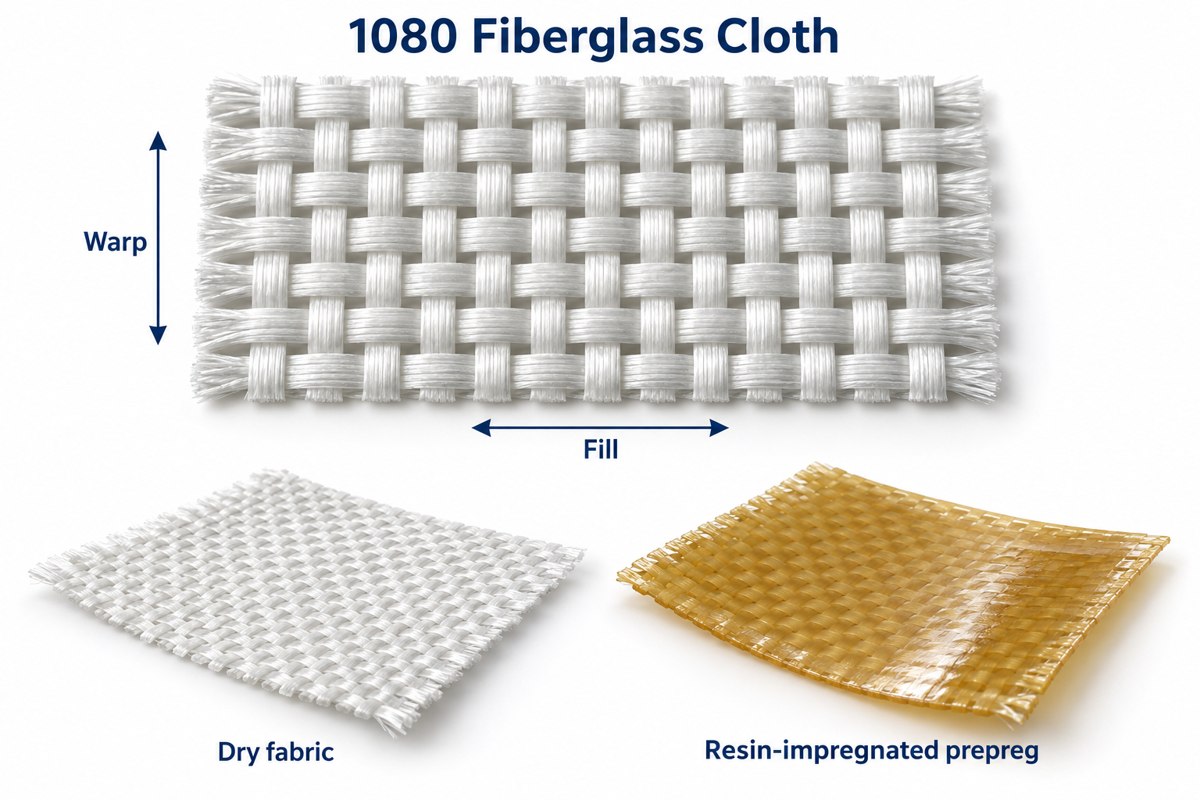
1080 fiberglass cloth is a lightweight plain-weave fabric made from fine glass yarns, with warp and fill yarns crossing at right angles.
Electronic-grade versions provide reinforcement for the resin between PCB copper layers. The glass supports dimensional stability; the cured resin binds the structure and fills the spaces around the yarns and copper features.
At EBest Circuit, we support FR-4 PCB fabrication, including multilayer and thin-board projects. We review the material construction alongside the board thickness and electrical requirements, rather than treating “1080” as a complete material order specification.
What Are the Dimensions and Weight of 1080 Glass Cloth?
A representative 1080 construction has 60 warp yarns and 47 fill yarns per inch, with dry-fabric weight close to 49 g/m² and thickness near 0.06 mm.
| Property | JPS Style 1080 data |
|---|---|
| Glass type | E-glass |
| Weave | Plain |
| Warp yarn | ECD 450 1/0 |
| Fill yarn | ECD 450 1/0 |
| Warp count | 60/inch |
| Fill count | 47/inch |
| Dry fabric weight | 49 g/m² |
| Fabric thickness | 2.2 mil; 0.06 mm as rounded in the source |
JPS describes these as typical greige values unless otherwise noted. Greige means fabric before subsequent finishing. Other suppliers publish different nominal values: Fulltech lists 47 ± 2 g/m², while Yaosheng lists 48 ± 3 g/m² and 0.053 mm. These examples explain why a controlled specification should identify its supplier and material condition.
Why Is 1080 Used in Thin PCB Stackups?
1080 is used when a stackup needs relatively thin reinforced dielectric layers between copper layers.
Reducing dielectric spacing can help meet a thin-board target or achieve a required impedance with a particular trace width. The benefit is geometric: a thinner glass reinforcement leaves more options for the dielectric build. It does not automatically improve signal loss or thermal reliability.
- Thin multilayer boards: reduce the contribution of individual dielectric layers to total thickness.
- Closely coupled layers: establish the required signal-to-reference-plane spacing.
- Selected HDI constructions: fit thin reinforced layers where the material, via geometry and lamination process are compatible.
Some HDI designs use other fine glass styles or non-glass-reinforced build-up films. The required microvia structure and material system decide which option fits; 1080 is not mandatory for HDI.
What Determines 1080 Prepreg Thickness?
1080 prepreg thickness is determined by the resin-containing construction, while its finished laminated thickness also depends on resin flow and copper coverage.
Isola’s 370HR prepreg table provides these examples:
| Glass style | Resin content | Listed thickness |
|---|---|---|
| 1080 | 61% | 0.070 mm |
| 1080 | 66% | 0.076 mm |
| 1080 | 68% | 0.081 mm |
Use these as named material examples, not as a thickness range guaranteed for every 1080 prepreg material. A finished stackup must account for the actual resin system and lamination process.
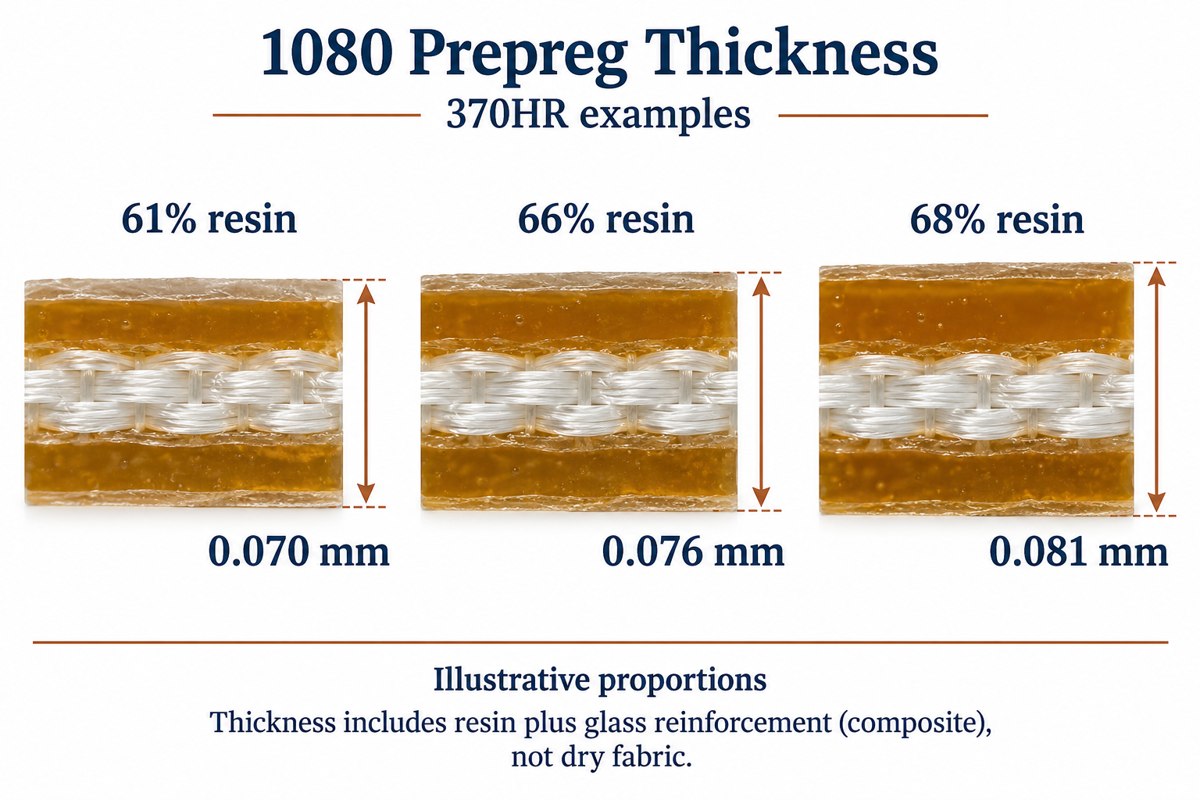
When reviewing a drawing, distinguish three measurements: dry cloth thickness, the supplier’s prepreg construction thickness, and the dielectric spacing measured in the finished board. They answer different questions.
Should a PCB Use One or Two Plies of 1080?
Use one or two plies according to the required dielectric spacing and resin volume; neither choice is universally correct.
A single ply may fit a thin spacing target when the selected construction provides adequate fill and insulation. Two plies can provide a different resin and reinforcement build, but they also change thickness and material distribution.
- Start with the copper-to-copper dielectric target, not sheet count alone.
- Review the thickness and area of copper that has been etched away.
- Check the resin available from the proposed prepreg construction.
- Confirm the final build through the fabricator’s stackup calculation and qualification data.
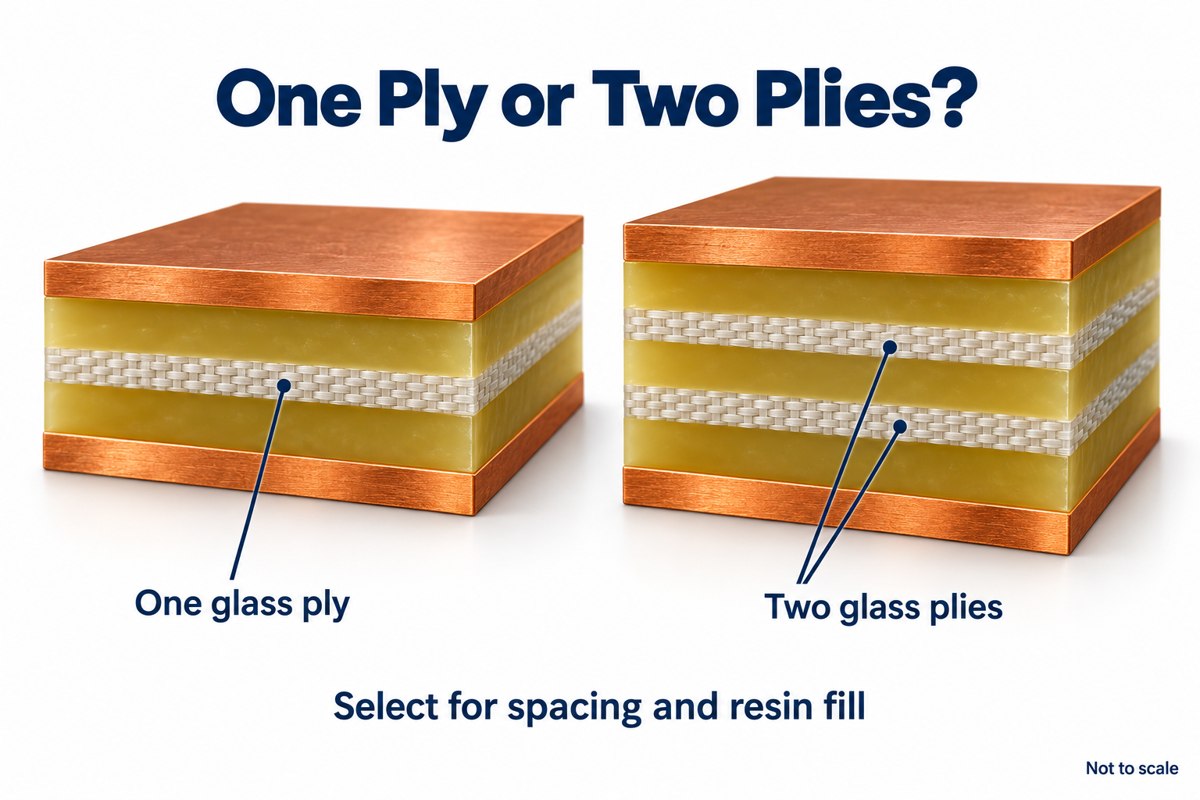
For example, doubling a listed 0.076 mm sheet value gives 0.152 mm arithmetically. That calculation alone does not prove a 0.152 mm finished spacing over an etched inner layer, because resin moves during pressing.
What Is the 1080 Prepreg Dielectric Constant?
There is no single 1080 prepreg dielectric constant: Dk changes with resin formulation, resin content, frequency and test method.
The same glass style can be used in conventional FR-4, high-Tg and other laminate formulations. Their electrical data are not interchangeable. For controlled impedance, specify the actual material grade and construction, then use the appropriate design data for the operating frequency.
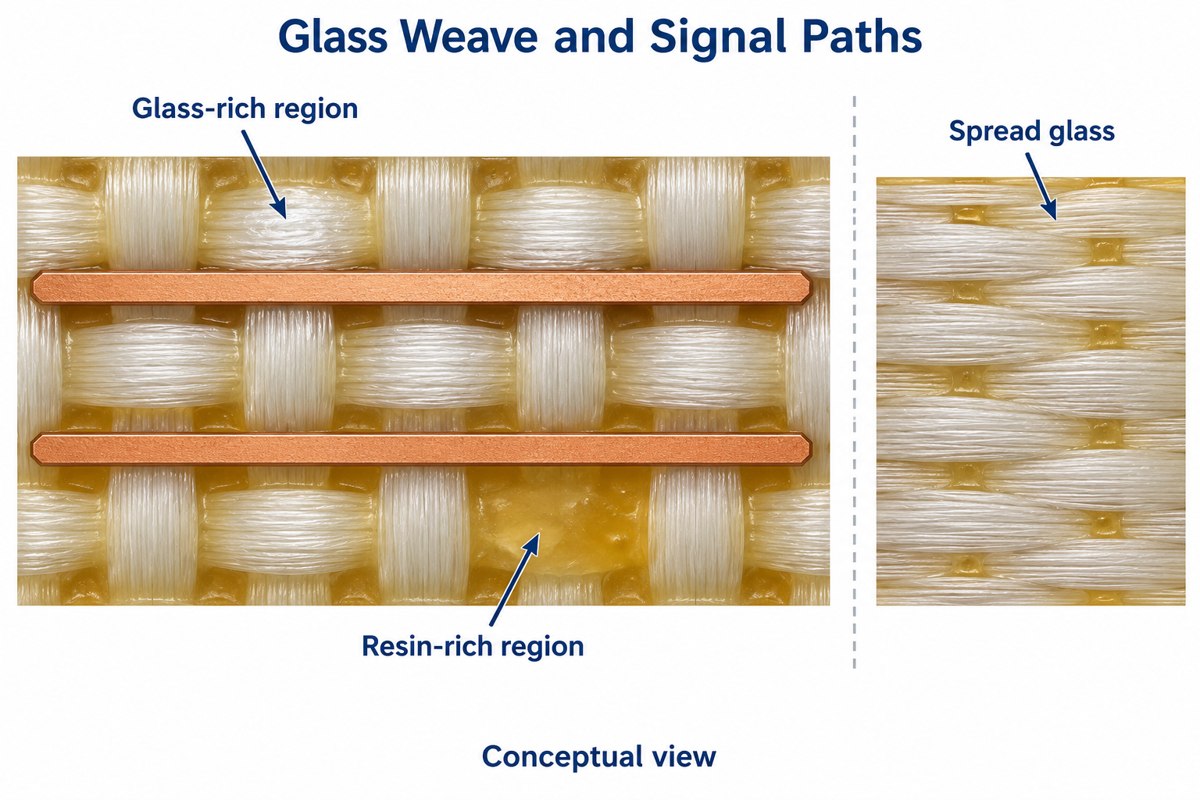
Local glass-weave effects matter too. A trace over glass-rich regions encounters a different dielectric environment from a trace over resin-rich gaps. Differential pairs can see unequal propagation delay when that imbalance persists along their routes. Spread glass, trace orientation and routing choices can reduce the problem, but must be assessed for the specific channel.
How Does 1080 Differ from 2116?
1080 uses a lighter, thinner reinforcement than 2116, so it is often considered for smaller dielectric spacing; 2116 contributes more glass per sheet.
Yaosheng’s published nominal examples are 0.053 mm and 48 g/m² for 1080, compared with 0.094 mm and 105 g/m² for 2116. These are dry-fabric values. They do not mean that every 1080 prepreg is thinner than every possible 2116-based finished construction.
A substitution changes the glass-to-resin balance and may change impedance, resin fill and dimensional behavior. Keep the approved resin grade and stackup targets visible when evaluating either style. Our prepreg overview explains how reinforcement and resin work together.
What Manufacturing Problems Need Attention with Thin 1080 Layers?
Resin starvation, dielectric-thickness variation and handling damage deserve particular attention when thin 1080-based layers are used.
- Resin starvation: etched copper gaps can consume more resin than the chosen construction supplies, leaving inadequate fill.
- Thickness variation: resin flow and uneven copper distribution can change spacing locally.
- Handling damage: creased, contaminated or damaged prepreg should not be hidden inside the stackup.
- Misregistration or distortion: material movement and an unbalanced build can affect layer alignment and board flatness.
Useful checks include material identification, microsection inspection, dielectric-thickness measurement, finished-board flatness and electrical continuity/isolation testing. Controlled-impedance boards also need the agreed coupon measurements. The acceptance limits should come from the approved drawing and applicable product requirements.
FAQ About 1080 Glass Cloth
Is 1080 glass cloth already coated with PCB resin?
Not necessarily. Dry cloth is reinforcement. Prepreg is the resin-impregnated, partially cured material used for bonding layers.
Does 1080 mean the fabric is 1.080 mm thick?
No. 1080 is a fabric-style designation, not a thickness measurement.
Can 1080 make a finished PCB flexible?
No. A thin glass cloth may drape before curing, but the completed board’s flexibility depends on its entire material construction. A rigid FR-4 board does not become an FPC simply by using 1080.
Can 1080 be used with lead-free assembly?
Yes, when the chosen laminate and prepreg resin system is qualified for the required assembly profile. The glass-style number alone does not establish reflow suitability.
Is 1080 always the lowest-cost choice for a thin board?
No. Total fabrication cost also depends on ply count, material availability, copper features, lamination steps and yield. A thinner fabric does not guarantee a cheaper finished PCB.
How Can EBest Circuit Help with Thin PCB Materials?
We can review the proposed 1080 construction against your board thickness, dielectric spacing and fabrication requirements, then support PCB production and PCBA services.
For a thin-board design with uncertain layer spacing or resin fill, contact sales@bestpcbs.com. Our engineering review can help turn a glass-style note into a defined, manufacturable stackup.
Tags: 1080 fiberglass cloth, 1080 Glass Cloth, 1080 prepreg dielectric constant, 1080 prepreg material, 1080 prepreg thickness
PakarPBN
A Private Blog Network (PBN) is a collection of websites that are controlled by a single individual or organization and used primarily to build backlinks to a “money site” in order to influence its ranking in search engines such as Google. The core idea behind a PBN is based on the importance of backlinks in Google’s ranking algorithm. Since Google views backlinks as signals of authority and trust, some website owners attempt to artificially create these signals through a controlled network of sites.
In a typical PBN setup, the owner acquires expired or aged domains that already have existing authority, backlinks, and history. These domains are rebuilt with new content and hosted separately, often using different IP addresses, hosting providers, themes, and ownership details to make them appear unrelated. Within the content published on these sites, links are strategically placed that point to the main website the owner wants to rank higher. By doing this, the owner attempts to pass link equity (also known as “link juice”) from the PBN sites to the target website.
The purpose of a PBN is to give the impression that the target website is naturally earning links from multiple independent sources. If done effectively, this can temporarily improve keyword rankings, increase organic visibility, and drive more traffic from search results.
Streaming Film
Nonton Film gratis
Jasa Backlink
Download Anime Batch